
The Case For Special Time

One of my favorite things to recommend to parents is something called Special Time.
It’s also one of the things that parents resist the most.
Not because they don’t love their children. Not because they don’t want connection. But because parenting is exhausting, modern life in 2026 is overstimulating, and the idea of sitting on the floor playing pretend for ten uninterrupted minutes can feel strangely impossible.
Trust me, I understand.
Special Time is something I still practice daily with my teen even though it looks different these days. After ten years of coaching families, I can promise you, it is one of the most effective tools I know for increasing connection, reducing power struggles, and helping children feel emotionally secure.
It’s also deceptively simple.
Special Time is daily, one-on-one, child-led play.
That’s it.
But inside that simplicity is something profound.
When I first heard my mentor, Dr. Laura Markham of Aha! Parenting, say that parenting is “80% connection and 20% coaching,” I honestly dismissed it. My teen was a newborn at the time, and although I had years of experience nannying and caring for children, I had been raised in a much more authoritarian environment. Parenting, in my mind, was about teaching children what to do and making sure they listened. Obedience and respect were the goals.
The idea that connection was the foundation of parenting felt permissive to me. Maybe even indulgent. The last thing I wanted to do was parent how I was parented but the next to last thing I wanted to do was raise an entitled only child
But thankfully, I stayed curious which eventually led to me training with Dr. Markham to become a Certified Peaceful Parenting Coach
During my training, as I learned more about attachment, neurobiology, emotional regulation, and child development, I began to understand something that now feels undeniably true:
Connection creates cooperation.
It’s not ruling by fear or yelling or expecting “first time listening.” It’s not policing our children for any sign of “disrespect” and punishing them if they speak out of turn
Connection is the way. Simple but not easy
Every human being wants to feel seen, heard, valued, and emotionally safe with the people they love. Children are no different. In fact, they need it even more.
Special Time gives children exactly that.
One of the reasons Special Time is so powerful is because children spend most of their lives feeling fundamentally powerless. And appropriately so. They shouldn’t be making major life decisions. But it still means they spend much of their day being told what to do, where to go, how to behave, when to stop, when to hurry, when to share, when to clean up, and when to go to bed.
Special Time flips that dynamic. For ten minutes, they lead. They decide what to play. They decide the roles. They decide the storyline. And our job is simply to follow.
Children love the ritual of it. Naming it matters more than you might think. Timing it matters too. I can’t fully explain why, but after years of doing this work, I’ve seen over and over that the structure itself changes the emotional experience for children. Even older kids tell me it feels more important when it has a name and a beginning and an end.
During Special Time, we are telling our child, “You matter enough for me to intentionally set aside this time for you.” I think this is exactly what sets it apart from other time.
That kind of focused attention is incredibly regulating for children.
Parents often tell me, “But I already spend all day with my kids.” I understand that. Especially for homeschooling parents, stay-at-home parents, or parents whose children are constantly nearby. But being physically near our children is not always the same thing as being emotionally connected to them. Just as being physically near our partners is the same as a date night or even a real conversation.
We can be sitting beside our child while mentally writing emails, worrying about bills, planning dinner, or trying to survive the day. Special Time asks us to practice something most of us struggle with: single-point attention.
It’s ten minutes of being fully present, to the best of your ability. That’s part of why it works so well.
Is it always a joy and delight to do? Of course not. I cannot tell you how many parents have admitted to me, often in whispers, “I hate playing.” Honestly? I think that’s far more common than people realize.
Some adults didn’t grow up playing imaginatively. Some feel awkward. Some feel bored. Some are exhausted. Some feel silly. I was one of those people. As a child, I always had my nose buried in a book. Imaginative play did not come naturally to me at all. Meanwhile, from about ages three to six, my kiddo wanted me to pretend to be a cat every single day.
So I became a cat for years. Take note that this family lore made it into the infographic…
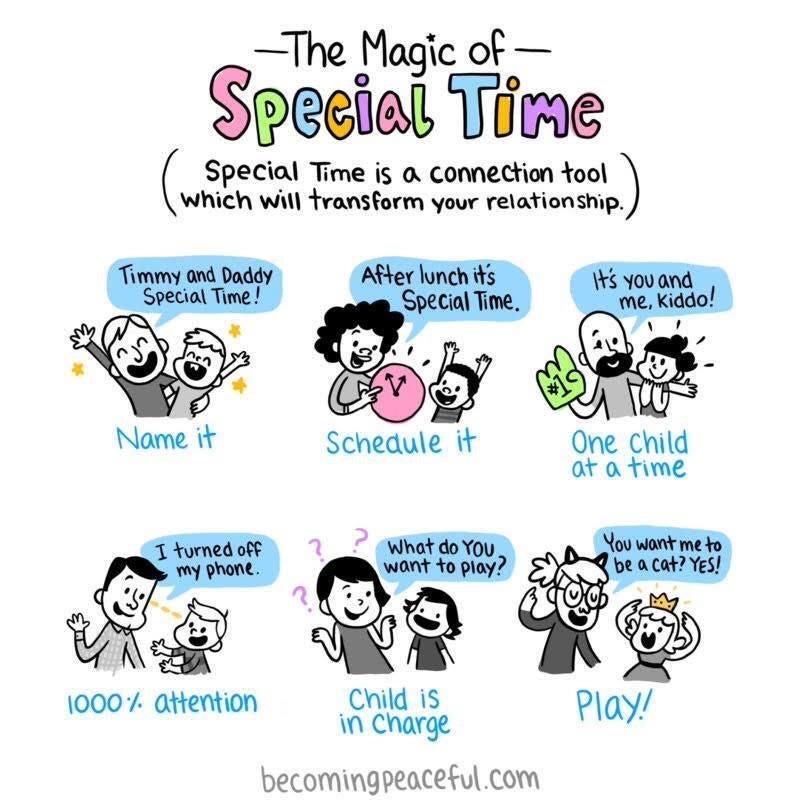
I often tell parents: you gave birth, or survived infertility, or foster care, or adoption paperwork, or sleepless nights, or postpartum anxiety. You can absolutely meow on the floor for ten minutes. If I can do, you can too. I will even admit, I actually miss that kind of play.
Play is incredibly regulating for adults too. It softens us. It reconnects us to joy, silliness, creativity, and presence. Laughter releases some of the same endorphins as tears and reduce stress and overwhelm.
Children process life through play. They work through fears, transitions, frustrations, and experiences symbolically. Every year around back-to-school season, parents tell me their children suddenly want to “play school” during Special Time. The teacher is strict. The rules are unfair. The students get in trouble.
They are processing their world. When we join them there instead of constantly leading, correcting, or teaching, we deepen connection in a very meaningful way.
One of the biggest concerns parents have is ending Special Time. When you first start, your child may cry when it’s over. That’s normal. Why wouldn’t they complain the end of something they love?
The important thing is consistency. When Special Time happens regularly, you can confidently say: “I know you’re sad it’s ending. I’m having so much fun too, and we’ll do it again tomorrow.”
All humans do better when they can count on things. It creates a sense of security and predictability. We won’t be perfect because we are human and life happens. But we can try.
Part of peaceful parenting is also understanding that emotions are not emergencies. Tears are not failures. Disappointment is survivable. We don’t have to fix every feeling our child has. Sometimes we simply stay with them in it. Let them ride the wave of their emotions with us holding that space alongside them. Feelings come and feelings go, promise
Another concern I hear often is: “But I have multiple kids.”
Of course, that makes this harder.
I have enormous empathy for families juggling several children, single parenting, military deployments, chronic illness, financial stress, or children with additional needs. Parenting advice that ignores logistical reality isn’t particularly helpful.
So here’s what I tell parents: Be creative.
I once worked with a family with ten children. They literally had a spreadsheet for Special Time rotations. Some children got five minutes. Some got longer weekend sessions. Older siblings sometimes did sibling Special Time with younger children. One child watched a show while another had one-on-one time.
There is no perfect formula. Any intentional connection is better than none. Even five minutes can shift the emotional climate of an entire evening.
That’s what I think parents often miss. We are going to spend the time regardless. We can spend it proactively building connection, or we can spend it reactively managing meltdowns, conflict, resistance, and dysregulation later. In my experience, the preventative maintenance is almost always easier.
You don’t have to be perfect and you don't have to love it. Will it instantly change everything? Of course not. We are human beings so strengthening connection takes time and intention. But it works.
What might happen if you tried Special Time - ten minutes of one-on-one, child-led play?
You do not need to be an amazing entertainer. You do not need to be naturally playful. You do not even need to leave the house or buy a single thing.
You just need presence.
Isn’t that what our children are asking for all along?
I needed this reminder. It feels impossible to start Special Time, but it’s truly magical.
I can vouch - special time works! Thanks for the reminder. Easy to get out of the flow of scheduling it as well.